From the Sparkle of Diamonds to Finding Her Wings in the Sky | The Story of Anna Mani — and Why Her Journey Is Still Relevant
Some stories stay with you because you find a piece of your own journey in them. Anna Mani’s is one of those. Born in 1918 in the hills of Kerala, she chose books over jewellery, studied diamonds in C.V. Raman’s lab, never received the doctorate she had earned, and still rose to lead teams that built independent India’s weather instruments—and mapped its solar and wind resources decades before the energy transition. On her birth anniversary, P3 celebrates a scientist who did not just dream of touching the sky. She taught us how to measure it.
 P3Publications
Some stories stay with you. Not just because they are extraordinary or inspiring, but because somewhere deep down, you find a small reflection of your own journey in them.
For me, Anna Mani’s story is one of those stories.
This month at P3, we celebrate the birth anniversary of Anna Mani, one of the pioneering women of Indian science. Being a woman in atmospheric science myself, I feel particularly excited to share her story. What fascinates me is not only what she achieved, but how relevant so many parts of her journey remain even today.
But who was Anna Mani?
She was a physicist and meteorologist, and one of the pioneering women of Indian atmospheric science. She spent nearly three decades at the India Meteorological Department and eventually rose to become a Deputy Director General of IMD. Her work ranged from meteorological instrumentation and atmospheric radiation to ozone, solar radiation and wind energy.
But behind those titles is a much more interesting human story.
And that story begins more than a hundred years ago, in a very different India and a very different society.
The year was 1918.
India was still under British colonial rule.
On 23 August, in Peermade, Travancore, in present day Kerala, Anna Modayil Mani was born, the seventh of eight children.
She grew up in a relatively affluent Syrian Christian family. Her father was a civil engineer and owned a large cardamom estate in the high ranges of Kerala. He was known for a rational outlook and was reportedly an agnostic. Far less has been recorded about Anna’s mother, including her education or professional life, and I would rather leave that part of the historical record as it is than fill the silence with assumptions.
Anna grew up in a large household of eight children. Education was valued, but sons and daughters did not necessarily inherit the same possibilities from that education.
That distinction matters.
Anna certainly had privileges. Her family was financially secure, and she had access to education and books that many girls of her generation simply did not have.
But financial privilege and freedom of choice were not necessarily the same thing, particularly for a girl growing up in India at that time.
Even when a family could afford to educate its daughters, education did not automatically bring the freedom to build an independent professional career. Marriage, motherhood and family were still widely considered the expected course of a woman’s life.
Anna somehow kept looking beyond that.
She was a voracious reader.
And there is one story from her childhood that particularly fascinates me.
When Anna was around eight years old, she was offered diamond earrings.
She chose an Encyclopaedia Britannica instead.
Perhaps at the time it was simply the choice of a curious little girl who preferred books.
But the diamond would return to her life in a way nobody could possibly have planned.
Anna went to Madras to study physics and chemistry and completed her B.Sc. Honours degree in 1939. Her academic ability then earned her a scholarship for research at the Indian Institute of Science in Bangalore.
And there, the little girl who had chosen an encyclopedia instead of diamond earrings found herself in the laboratory of Sir C. V. Raman, India’s Nobel laureate in Physics, studying...
diamonds and rubies.
Not wearing them.
Studying them.
She investigated their optical properties, including fluorescence, absorption and spectroscopy, trying to understand how light interacts with these crystals. She published several scientific papers and continued her doctoral research.
At this point, one might imagine there was no looking back in her scientific journey.
Then came something few would have expected.
In 1945, Anna submitted her doctoral dissertation.
She had done the research.She had published the papers.
She had submitted the thesis.
But she did not receive the PhD.
The reason was not that her research had been rejected as scientifically inadequate. She reportedly did not possess the master’s degree required under the university regulations for the award of the doctorate.
When I first came across this part of her journey, it stirred something within me and opened up many questions.
How do we measure intellectual merit?
Academic standards matter. Degrees, grades and qualifications have their purpose. A strong education system needs rigor.
But how do we make sure that the conventional sequence of degrees, grades, examinations and eligibility requirements does not become our only measure of intellectual ability?
Where do we place demonstrated research ability, originality, creativity and the capacity to produce new knowledge?
And perhaps the harder question is this:
How many potentially brilliant minds might we have lost because, unlike Anna, they did not keep going after being filtered out by a grade, a qualification, an entrance requirement or a rigid academic pathway?
This is not an argument against academic standards. It is an open question for science and education policy.
How do we maintain standards without allowing the very system designed to recognize merit to occasionally become the reason we fail to recognize it?
Anna Mani’s story does not answer that question.
It asks us to keep asking it.
Anna, however, kept going.
In 1945, another door opened.
She received a Government of India scholarship to travel to Britain for specialized training.
She had hoped to continue in physics. Instead, the opportunity took her into something completely new: meteorological instrumentation.
What might have appeared to be a detour became one of the defining turns of her scientific life.
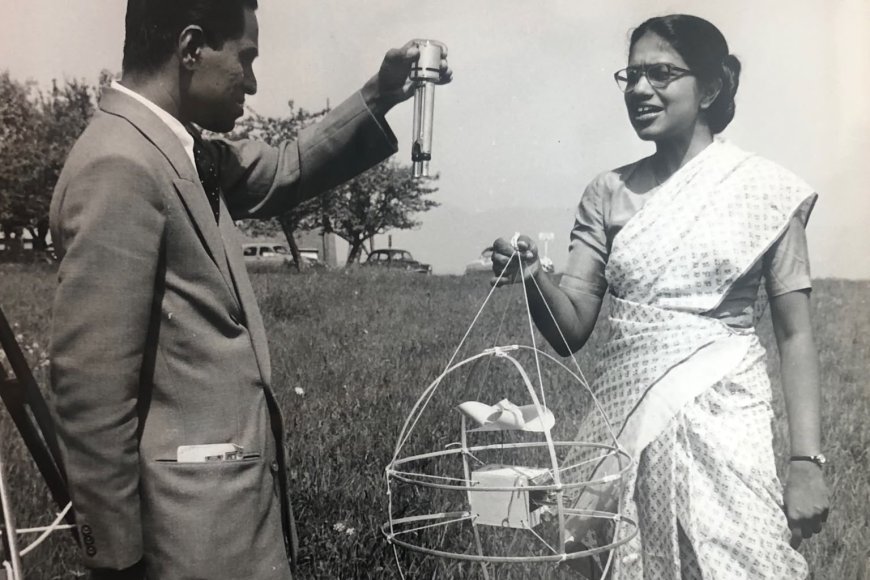
She learned how instruments used to observe the atmosphere were designed, calibrated and standardized.
And while Anna was acquiring this new expertise abroad, India itself was changing.
In 1947, India became independent.
Anna returned home and in 1948 joined the India Meteorological Department in Pune.
Think about the timing.
A woman born in colonial India had travelled abroad, acquired a new scientific skill set, and returned just as an independent India was beginning the enormous task of strengthening its own scientific and technological capabilities.
And India urgently needed reliable meteorological observations.
For a country where agriculture, water resources, food security and millions of livelihoods depended so closely on rain and weather, measuring rainfall, temperature, humidity and wind was never simply a scientific exercise.
When will the rain arrive?
How much rain will fall?
What will the temperature and humidity be?
How strong will the wind be?
These were scientific questions, but they were also questions of everyday life. They mattered to the farmer waiting to sow a field, to crops needing water, to communities planning around changing weather, and ultimately to the country’s food supply and economy.
And before we can understand or forecast the atmosphere, we first have to measure it properly.
That was the world Anna Mani entered at IMD.
She worked with teams of scientists, engineers and technical personnel on the design, calibration and standardization of meteorological instruments.
And I think the word team matters.
Scientific history often remembers individual names, but scientific infrastructure is built collectively. Anna’s contribution was not the story of one scientist building everything alone. She became an important scientific and technical leader within a much larger institutional effort.
Her responsibilities grew remarkably quickly.
By 1953, only about five years after joining IMD, she was heading a division with around 121 people working under her leadership. Together, these teams contributed to strengthening India’s ability to develop and standardize meteorological instruments and build its own observational capabilities.
Her scientific world continued to expand.
Her work on solar radiation and wind becomes even more fascinating when viewed from where we stand today.
We now talk constantly about renewable energy, climate change, solar power, wind power and energy transition.
But before we can say how much solar energy a region can produce, someone first has to measure how much solar radiation actually reaches it.
Before we can develop wind energy, someone has to understand where the wind blows, how strongly it blows and how it changes over time.
Anna Mani was working on these fundamental measurements decades before the energy transition became the global conversation it is today.
Her responsibilities at IMD continued to grow, and in 1969 she became a Deputy Director General of the India Meteorological Department.
She retired from IMD in 1976, after nearly three decades of service.
But she did not retire from science.
She continued working on solar and wind energy resources and produced important reference works on solar radiation over India, including the Handbook of Solar Radiation Data for India and Solar Radiation over India.
There is another part of her journey that I find particularly relevant today.
The Government of India had invested in sending a young scientist abroad to acquire expertise.
She returned with that knowledge.
She adapted it to India’s needs.
She worked with teams and institutions at home.
And later, her scientific journey became part of the wider international meteorological community, including work connected with the World Meteorological Organization.
To me, this is a powerful example of what science and education diplomacy can achieve.
International scientific exchange is not simply about collecting another degree or adding the name of a foreign institution to a résumé.
At its best, it is about the movement of knowledge.
People travel.
They learn.
They exchange ideas.
They bring knowledge home.
That knowledge is adapted to local needs, shared with others and becomes part of institutions and national capabilities.
And eventually, it travels again.
Atmospheric science makes the importance of this exchange particularly clear.
We draw borders on maps.
The atmosphere does not.
Rain does not need a visa.
Wind does not carry a passport.
Weather systems move across countries irrespective of politics.
Scientific self reliance therefore does not have to mean scientific isolation.
A country that develops strong scientific capabilities at home can become a stronger scientific partner to the world.
And perhaps that is why Anna Mani’s story stays with me.
It was not a perfectly straight journey.
It began with a curious little girl and a book.
Then came physics.
Then diamonds.
Then a doctorate that never arrived.
Then an opportunity abroad.
Then an entirely new scientific direction.
Then instruments, rain, wind, sunlight and ozone.
And eventually, scientific leadership.
What looked like a setback did not become the end.
What looked like a detour became a destination.
And an opportunity given to one young scientist eventually became knowledge brought home to a newly independent country.
More than a century after her birth, Anna Mani’s journey still leaves us with questions about how we recognize talent, how we design our education system, how we invest in young scientists, and how knowledge acquired around the world can be brought home to build something meaningful.
But perhaps her life also says something much simpler to a young girl wondering whether one rejection, one grade, one missing qualification or one unexpected turn can decide her future.
Keep going.
The seventh child in a family of eight, the little girl from the hills of Kerala who once chose an encyclopedia over diamonds eventually studied those diamonds, changed scientific fields, travelled across the world, returned home, worked with teams of scientists and engineers, and rose to become one of the senior scientific leaders of the India Meteorological Department.
Anna Mani did not just dream of touching the sky.
She taught how to measure it.
Today, on her birth anniversary, we at P3 | People. Policy. Polity. celebrate Anna Mani, an extraordinary woman of Indian science whose journey still gives us much to celebrate, and perhaps even more to think about.
Dr. Debanjana Das
Deputy Director & Head, Earth, Energy, Environment & Global Partnerships
P3 | People. Policy. Polity.
Sources & Credits: Based primarily on INSA Biographical Memoirs, WMO archives and other publicly available historical records. Images courtesy of WMO/credited original sources. AI-assisted tools were used only for minor editing and organisation.